
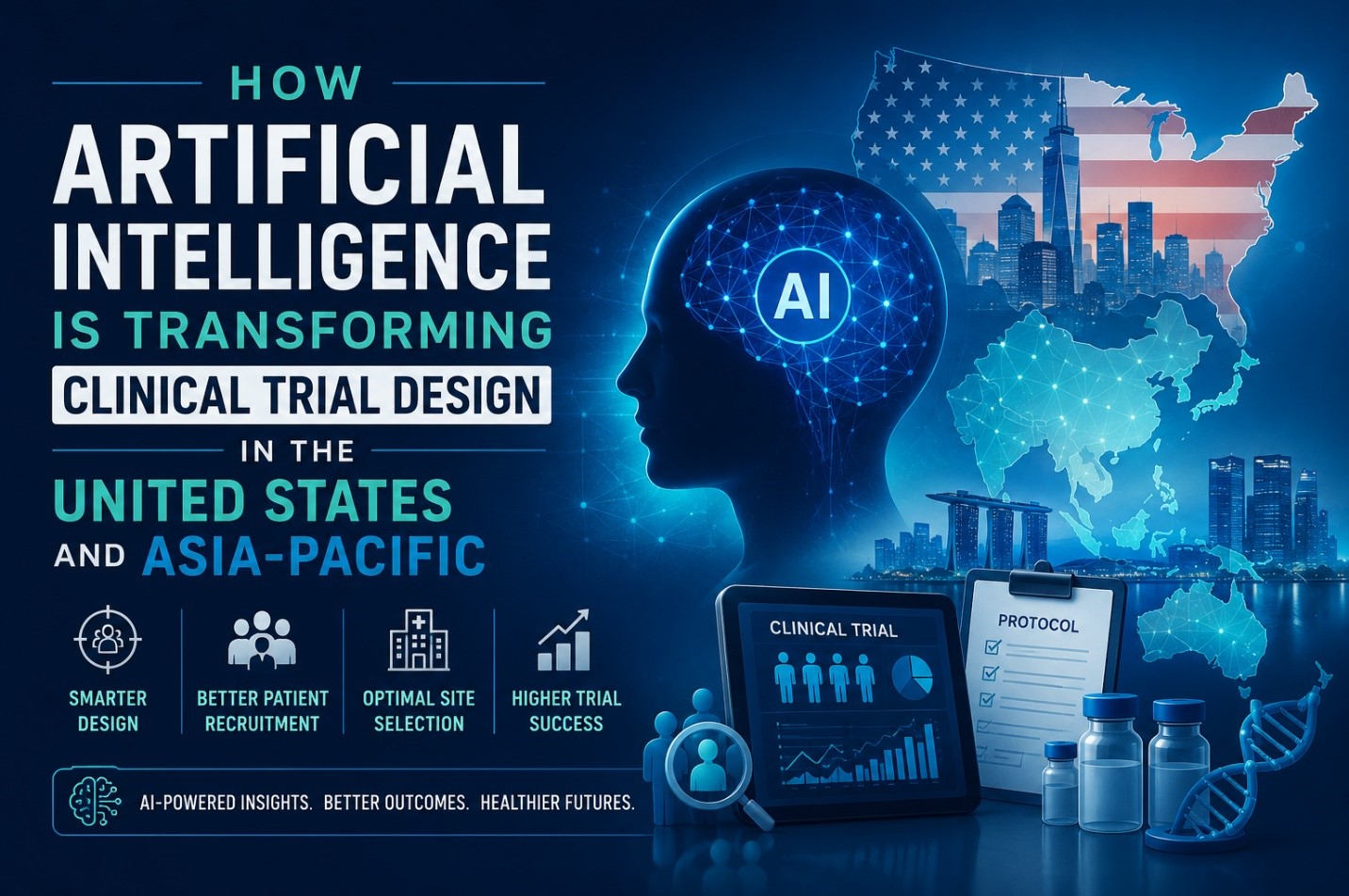
Over 400,000 trials were registered on ClinicalTrials.gov as of 2024, a 5-fold increase since 2005, strongly indicating that the global clinical trial arena has expanded rapidly, which is mainly due to the complex medical research. However, the huge challenges faced by clinical trials are evidenced by recruitment problems affecting 80%, increased pharmaceutical R&D spending (exceeding $200 billion annually), a success rate of less than 12%, and data quality issues in 50% of existing datasets. The use of artificial intelligence (AI) brings new ways to address these systemic inefficiencies during the course of a clinical trial. AI represents a force that causes disruption in clinical studies with the potential to enhance productivity, decrease costs, and improve clinical results. Even though the US still remains the largest region driven forward for AI-enabled drug discovery, the APAC region is starting to become a prolific regional hub for conducting clinical trials owing to its large patient pools and significantly expanding digital health infrastructure (Olawade et al., 2026).
Reasons for Improving Conventional Clinical Trial Design
It is much more difficult to plan a successful clinical study than it is to test a novel drug. Researchers need to ascertain the following:
Who ought to take part?
How many patients are required?
Which medical facilities or research facilities ought to be mentioned?
Which results are appropriate to measure?
What is the ideal duration for the study?
What dangers could arise?
Just one mistake in designing, for example, may cause the delay, alteration of protocol, increased cost, or even failure of the complete trial. The industry reports that many clinical trials do not recruit sufficient volunteers quickly enough. Several trials are unable to provide the crucial data required for regulatory approval or have procedural violations.
Use of AI in Clinical Trial Design
Artificial intelligence (AI) and machine learning (ML) techniques are becoming more and more popular in a variety of fields, including clinical research, with several opportunities. They can improve success and efficiency at every level of clinical trials (CTs), simplify clinical settings, and lessen the risk of failure. Published in December 2023 by the European Medicines Agency (EMA) and the European Medicines Regulation Network of EAM The draft reflection paper on the application of artificial intelligence in the life cycle of a medicinal product is also to be considered and indicates, "The statistical analysis plan (SAP) should specify more precisely how the data will be handled in terms of safety (safety management plan), and the protocol should be more specific about how the AI will be used and the risk/benefit (ICH E6)" (Kanapari et al., 2025).
Creating Improved Clinical Protocols
AI-driven protocol optimization signifies a major change from trial design based on subjective judgment to planning based on evidence. Large databases of past trial data are analyzed by sophisticated machine learning (ML) algorithms, which find patterns that guide the best study parameters. In order to provide evidence-based inclusion/exclusion criteria, natural language processing (NLP) algorithms methodically gather information from hundreds of previous study protocols, regulatory submissions, and published literature. These AI-driven techniques show notable advantages over conventional statistical methods: machine learning algorithms can process thousands of variables at once, achieving 80% accuracy in protocol optimization compared to 65% accuracy with traditional regression-based approaches, whereas conventional feasibility assessment relies on limited historical data and clinical intuition (Olawade et al., 2026).
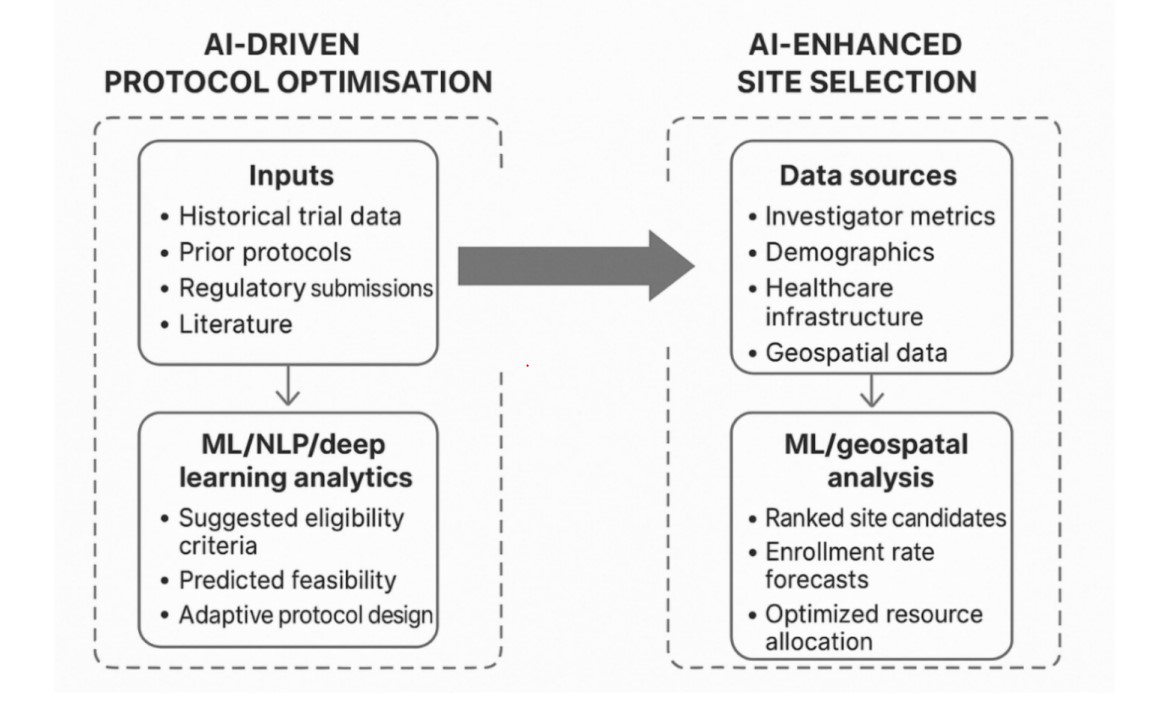
Figure 1. Schematic overview of artificial intelligence integration in clinical trial protocol optimisation and site selection (Olawade et al., 2026)
Enhancing the Recruitment of Patients
Clinical trials have seen a major digital revolution as a result of the COVID-19 outbreak. Clinical trials are increasingly interested in using AI and big data analytics, particularly for recruitment. Rising agreements for drug development operations, record levels of finance, and the growing number of companies functioning in this field are all evidence of this. Additionally, research by Chopra et al. shows that the use of AI in patient identification is extremely common, particularly when it comes to social media data analysis. AI can identify disease clusters in particular areas by analyzing online conversations from patient support groups. AI can help identify those who might benefit most from taking part in clinical trials by evaluating demographic data. AI has the ability to speed up the process of locating qualified volunteers by analyzing hospital medical data and alerting doctors and patients about possible clinical trial opportunities (Lu et al., 2024).
Choosing the Best Sites for Clinical Trials
AI is being used more and more to enhance the selection of clinical trial sites by evaluating various historical and real-world data sources instead of depending only on the reputation of the investigator or prior partnerships. Machine learning algorithms analyze data such as past recruiting success, patient eligibility, disease incidence, site infrastructure, investigator expertise, and compliance with protocols to determine which research sites are most likely to run a successful trial. This kind of approach reduces unnecessary costs and helps sponsors in identifying top sites and increasing the possibility of trial success (Kanapari et al., 2025).
Predicting Trial Success Rate Before it Starts
Estimating the probability that a clinical trial will meet its predetermined clinical or operational targets before or during a study is known as predicting clinical trial success. Statistical and machine learning models that incorporate trial design factors, past results, medication properties, patient eligibility requirements, and interim data are commonly used for this. To increase prediction accuracy, modern methods frequently mix natural language analysis of trial descriptions with structured data. Through early risk assessment, possibly resource allocation, and reduction in failures, such models aim to aid decision-making in drug development.
Monitoring in Real Time Throughout Clinical Trials
AI-powered continuous monitoring systems show better sensitivity and specificity than conventional monitoring methods that depend on recurring clinic visits and human data collection. While AI-based digital biomarker systems attain 90% sensitivity with real-time alarms, traditional monitoring usually yields 70–75% sensitivity for adverse event identification.
By identifying early warning indicators of undesirable events, progression of the disease, or treatment response, these artificial intelligence-powered monitoring systems lower the risk of major safety incidents and enable proactive clinical management. Table 1 shows the significant improvements in performance made possible by AI-driven monitoring systems, with especially good outcomes in data quality control and safety monitoring applications as compared to conventional human methods.
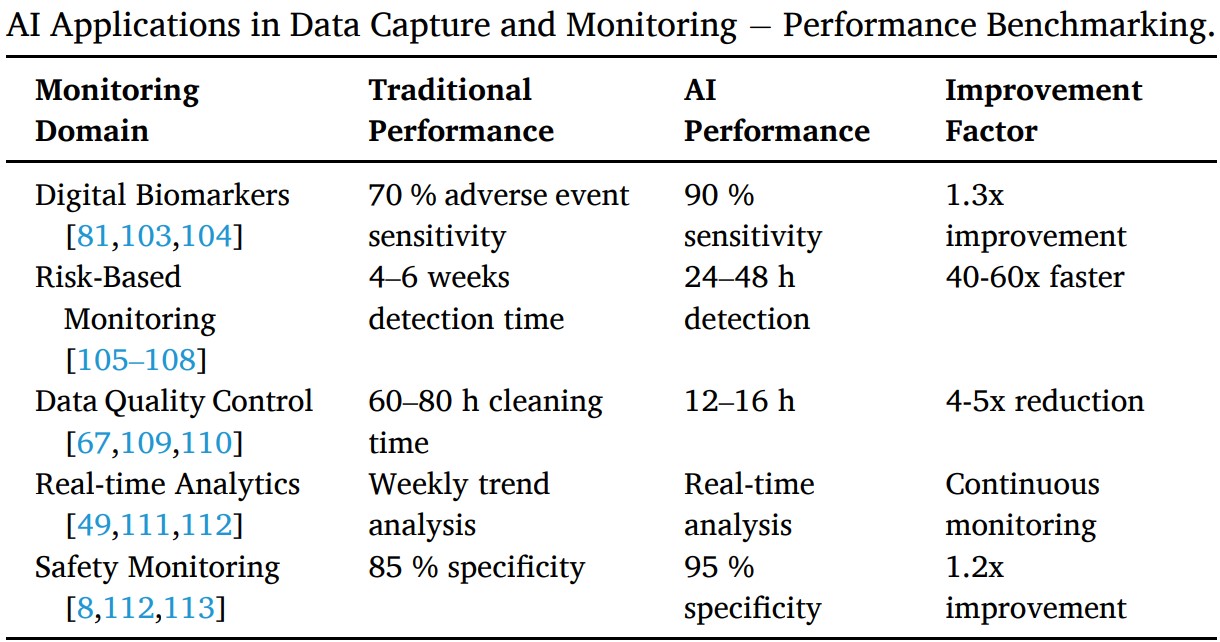
Table 1 (Olawade et al., 2026)
AI changes clinical study monitoring from site-visit-based, reactive methods to data-driven, proactive quality assurance solutions. In order to detect abnormalities, protocol deviations, and possible data integrity problems in real-time, machine learning algorithms examine data patterns across several sites (Olawade et al., 2026).
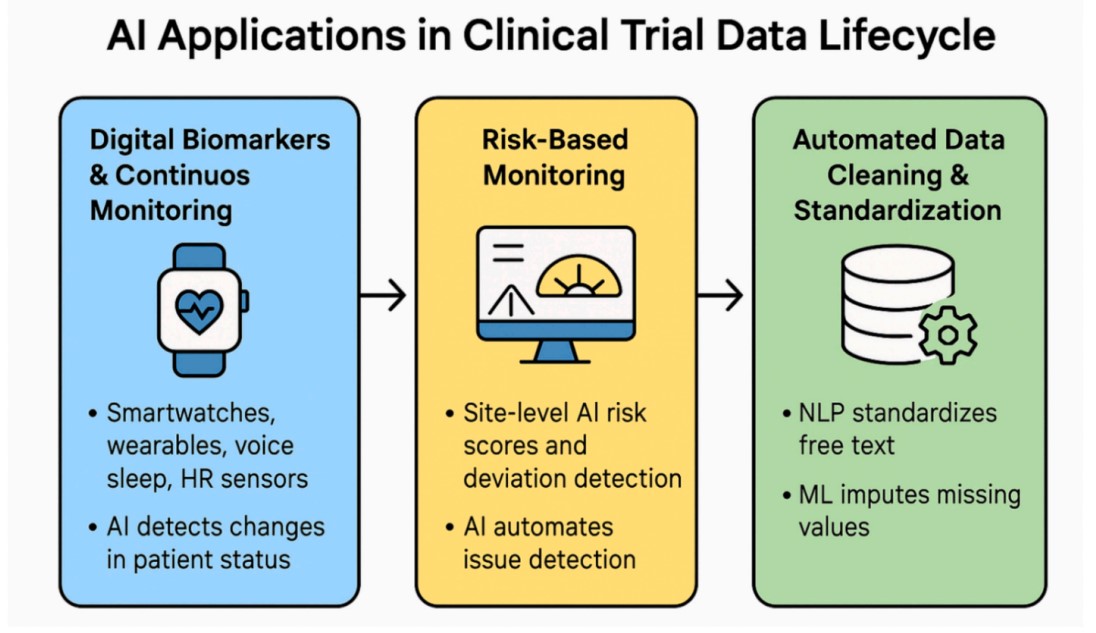
Figure 2. Applications of AI throughout the lifecycle of clinical trial data (Olawade et al., 2026)
Asia-Pacific: Developing as a Global Center for Clinical Trials
While the US continues to be the global technology innovator, the Asia-Pacific region is emerging as one of the fastest-growing regions for AI-enabled clinical research in the world. Countries including China, Japan, South Korea, Singapore, Australia, and India have a huge focus on the development of artificial intelligence and digital health infrastructure. APAC is particularly appealing for contemporary clinical studies for a number of reasons. First, around 60% of the world's population lives in the region, giving access to a wide range of therapeutic regions and extremely diverse patient groups. Second, the digital evolution of healthcare is growing quickly, resulting in bigger databases of electronic medical records and health information appropriate for AI applications. (Han et al., 2024).
Ethical and Regulatory Challenges
Since AI could worsen the existing healthcare inequalities, the application of AI in clinical trials can cause problems of bias in the algorithms and inequalities. The "black box" nature of most AI algorithms makes the clinical interpretation and approval by regulators very hard. A transparent description of the AI decision-making procedures is needed for regulators and healthcare providers to evaluate AI-based suggestions and whether they are appropriate and safe. The FDA, the European Medicines Agency (EMA), and other international organizations are among the regulatory bodies that are actively creating frameworks for evaluating AI. To promote innovation , it is crucial to establish clear and globally aligned regulatory pathways for AI-powered clinical trial tools (Olawade et al., 2026).
The Use of AI in Clinical Trial Design in the Future
Future research objectives should focus on developing thorough validation procedures for AI systems, providing explicit regulatory frameworks, and resolving the use of algorithms' bias and transparency concerns. To ensure ethical AI implementation, cooperation between regulatory bodies, clinical researchers, technology developers, and patient advocacy organizations will be essential (Olawade et al., 2026).
Conclusion
In clinical research, artificial intelligence is a crucial factor of today's clinical trial design. Artificial intelligence is being applied to most aspects of clinical research, including facilitating trials, recruiting patients, predicting trial results, and improving constant safety monitoring. While the US is driving technological innovations through its advanced pharmaceutical industry and biotechnology ecosystem, the Asia Pacific region has provided opportunities through the availability of a large multiethnic patient population, as well as the rapidly developing digital healthcare infrastructure. However, the ethical principles, data privacy, regulation compliance, and human supervision must be checked in order for AI to be successfully integrated. In conclusion, in the near future, AI will empower rather than replace clinical researchers, employing cutting-edge data technologies to improve health care outcomes for millions of patients around the world.
References
Han, R., Acosta, J. N., Shakeri, Z., Ioannidis, J. P. A., Topol, E. J., & Rajpurkar, P. (2024). Randomised controlled trials evaluating artificial intelligence in clinical practice: A scoping review. The Lancet Digital Health, 6(5), e367–e373. https://doi.org/10.1016/S2589-7500(24)00047-5
Kanapari, A., Lorenzoni, G., Ocagli, H., & Gregori, D. (2025). Current applications and future challenges of machine learning and artificial intelligence in clinical trials: A scoping review. DIGITAL HEALTH, 11, 20552076251393272. https://doi.org/10.1177/20552076251393272
Lu, X., Yang, C., Liang, L., Hu, G., Zhong, Z., & Jiang, Z. (2024). Artificial intelligence for optimizing recruitment and retention in clinical trials: A scoping review. Journal of the American Medical Informatics Association, 31(11), 2749–2759. https://doi.org/10.1093/jamia/ocae243
Olawade, D. B., Fidelis, S. C., Marinze, S., Egbon, E., Osunmakinde, A., & Osborne, A. (2026). Artificial intelligence in clinical trials: A comprehensive review of opportunities, challenges, and future directions. International Journal of Medical Informatics, 206, 106141. https://doi.org/10.1016/j.ijmedinf.2025.106141

 06 09 2024

 EN
EN  cn
cn  de
de  jp
jp