Decentralized Clinical Trials and Artificial Intelligence: The Future of Remote Research
In the past years, clinical research has followed a traditional model where participants visit hospitals or research centers as per the study design. The data is collected during these visits and handled in accordance with the study design. The COVID-19 pandemic has resulted in approaches that could bring clinical trials closer to participants and reduce the need for frequent visits to research centers. In 2020, the U.S. Food and Drug Administration (FDA) and the National Cancer Institute (NCI) issued guidance that provided greater flexibility in how clinical trials could be conducted. This included a range of regulatory and site-level adaptations, such as telemedicine consultations, visits conducted in participants’ homes, digital health technologies, laboratory testing and imaging performed locally, delivery of investigational products directly to participants, and electronic informed consent. These changes helped establish a more decentralized approach to clinical research. According to the FDA’s draft guidance, a decentralized clinical trial (DCT) is a trial in which some or all study-related activities are carried out at locations other than traditional clinical trial sites (Thota et al., 2024).
Need for Decentralized Clinical Trials
One of the main reasons for the growing interest in decentralized clinical trials is the difficulty of traditional research requirements in patients’ everyday lives. Traditional clinical trials can involve repeated visits to research centers, long-distance travel, arranging childcare, taking time away from work, and spending considerable time at specialized healthcare facilities. These demands can make participation difficult, particularly for people with limited mobility. (Regulations.Gov, n.d.).
The Role of Artificial Intelligence
Around 86% of clinical trials reportedly fail to meet their enrollment targets within the planned timeframe, and delays in recruitment can account for up to one-third of the total trial period. The problem becomes particularly important in phase III trials, which generally require large numbers of participants and have been reported to experience a 32% failure rate because of inadequate recruitment. Developing a new drug is a time-consuming and costly process. On average, it can take 10 to 15 years and cost more than US$1.5 billion before a drug reaches the market, with clinical trials accounting for a substantial share of both the time and the overall expense. Recruiting enough suitable participants is also a major challenge. There is potential for increasing trial efficiency through the use of artificial intelligence-based algorithms to optimize patient recruitment and selection (Goldberg et al., 2024).
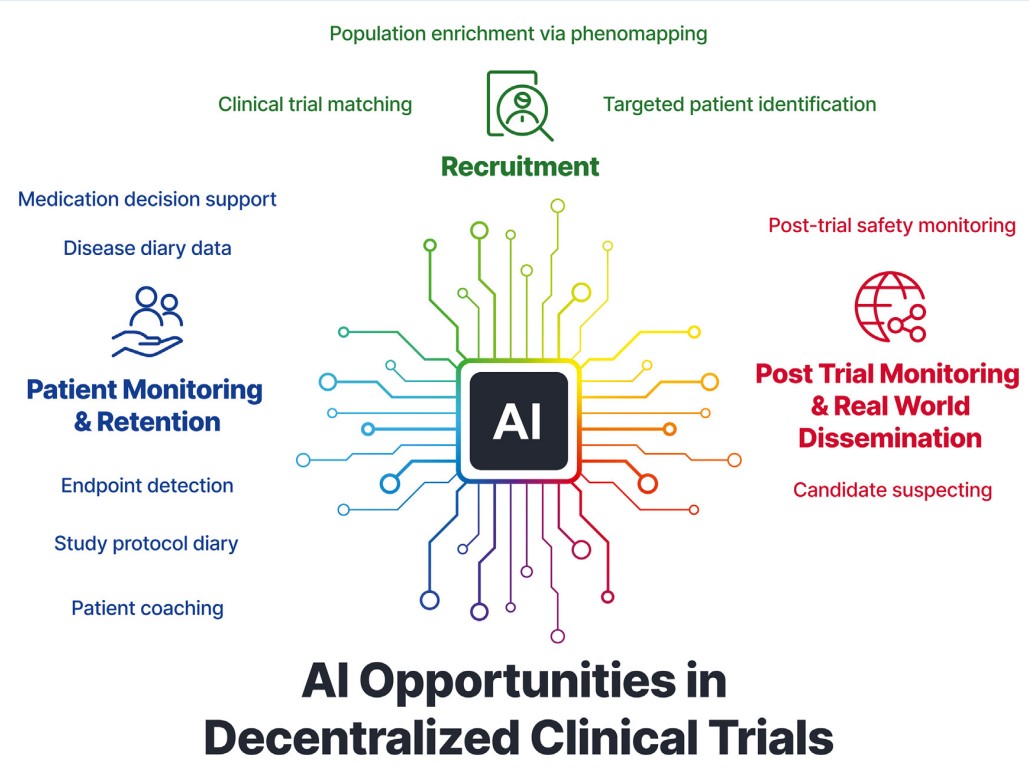
Figure 1. AI Opportunities in Decentralized Clinical Trials (Goldberg et al., 2024)
The Experience of the Patient Is Important
Even with difficult sample collection, the decentralized clinical trial methodology produced remarkable participant rates of retention (97%) and good clinical data completion rates. The excellent rate of retention and participant engagement was a result of the study team's primary point of contact, flexibility, and decreased time commitment of participation. Particularly during the pandemic, participants found the decentralized concept to be safe and convenient.
Here are a few sample quotes from the participants:
Convenience:
“All I have to do is just put aside some of my time. I think the fact
that everything has been given to me, even the [sample-collection
materials and all], we have to do is just wait for someone to collect
[it]. It was super easy, so I had no trouble with it.” (30–34 years old,
multiparous) (Fries et al., 2025).
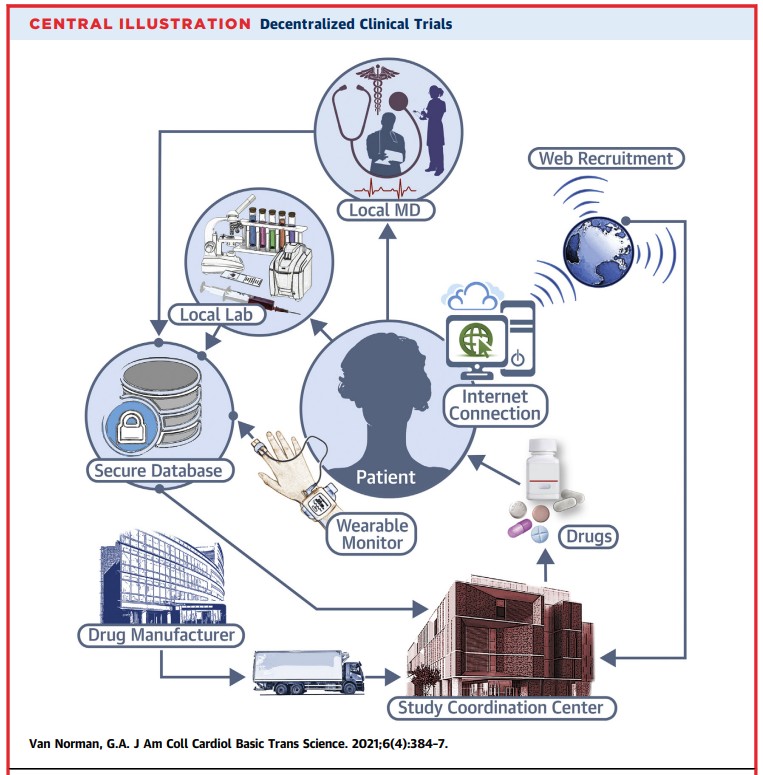
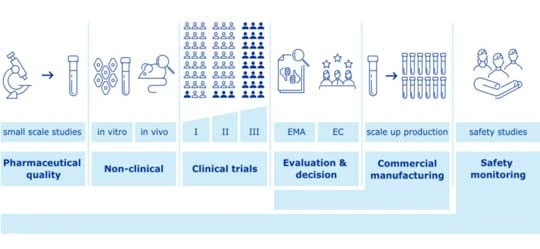
Figure 2. Digital Transformation in Clinical Trials (Van Norman, 2021)
Patient visits for laboratory testing and interactions with healthcare providers are localized in the patient's community in decentralized clinical trials. The person receiving treatment or the nearby medical facility receives the study's medications. Various other interactions, such as patient enrollment and monitoring, take place online, with data being electronically stored and secured (Van Norman, 2021).
The US Regulatory Landscape
The FDAs September 2024 final guidance explains how decentralized elements can be included in trials. It explains trial activities, digital health technologies, investigator responsibilities, informed consent, and safety monitoring. The FDA has also issued guidance on digital health technologies for remote data acquisition. These technologies can include hardware and software used to collect information from participants outside clinical settings. For sponsors this creates a shift in mindset. The FDA says the question is no longer simply whether remote technology can be used. Instead, sponsors need to show that the chosen approach is suitable for the trial participants and produces data. The FDA also encourages sponsors considering DCTs or digital health technologies to engage with the FDA during development (Regulations.Gov, n.d.).
APAC's Takeaways from the DCT Model
The Asia-Pacific region contains many opportunities but also a level of complexity for decentralized research. The various countries of Australia, Singapore, Japan, China, and South Korea have different healthcare delivery models, regulations, infrastructure, and quite a different approach to digital health. A decentralized framework that is successful in one market might require extensive modification in another. These differences across countries suggest that APAC sponsors should not approach decentralization as a single, standardized technology package that can be applied everywhere in the same way. Factors such as internet connectivity, language, cultural practices, the structure of the local healthcare system, availability of home-based care, and country-specific regulatory requirements all need to be considered when designing and implementing decentralized clinical trials.
AI-Powered Trial Challenges
Although artificial intelligence can make decentralized clinical trials more efficient by supporting data analysis and enabling remote monitoring of participants, its use also introduces several challenges. Researchers and trial sponsors must pay particular attention to protecting participants’ privacy, maintaining the accuracy and reliability of collected data, and ensuring clear accountability for decisions made with the help of AI systems. This is a diffusion of responsibility, as while countless entities and systems interact to influence trial results, it is often unclear who has the requisite expertise and authority over safety and data protection risk.
Safeguarding Data over the Whole Digital Environment
Therefore, rather than only safeguarding the sponsor's database, data security throughout the entire digital ecosystem brings a significant danger. Apps may miss crucial information, remote equipment may malfunction, and issues with data integration may influence AI judgments made later. The research points out that mistakes in electronic diaries or home testing equipment may affect the data that AI systems use, which could have an impact on clinical judgments (Muller et al., 2025).
AI's algorithmic risks and accountability problems
AI introduces further risk in complex models that can be difficult to interpret. The AI will recommend a dosage of individualized medicine based on physiological data, genetic data, environmental data, and lifestyle data. If the model incorrectly interprets a rare pattern or is based on poor data, then it may fail to recommend an exact dose. This introduces accountability issues as well as algorithmic risk.
Ethical and legal framework in DCT
Over the 10 years, various new models of clinical trials were gradually developed. Many ethical challenges arose from DCTs and digital health tools, such as recruitment, electronic informed consent, telemedicine, collection of patient-reported outcome measures, and safety monitoring. Effy Vayena et al. summarized these ethical issues into three areas requiring improvement:
1. personal safety and rights, such as self-storage and monitoring of investigated products and the protection of research participants’ privacy in the data age.
2. Scientific validity: The alternative design of replacing traditional site-based endpoints with digital endpoints or digital biomarkers needs to be scientifically validated.
3. Ethical governance: While the decentralized clinical trial and digital health tool adopted certain drawbacks of traditional trials, some factors still inhibit the acceptability of the model (Chen et al., 2025).
Hybrid Clinical Research
While the concept of fully remote trials is gaining a lot of attention, it is unlikely that hospitals and research sites will be superseded by smartphones and remote technologies. In practice, clinical trials are more likely to evolve toward a 'hybrid' model in which remote and traditional site-based elements are combined. A participant in such a trial would be able to undertake routine questionnaires on an app, wear a remote monitoring device at home, have their study medicines delivered to them, and have blood samples taken at the local GP's. However, individuals may still need to go to a specialized research facility for the use of magnetic resonance imaging or physical examination. By combining the various information sources that come up throughout a trial, artificial intelligence (AI) can enhance this approach. It might help research teams in managing data, offer trial participants remote support, or help with day-to-day trial administration. However, the biggest challenge will be to strike the right balance between in-person and virtual.
Conclusion
Artificial intelligence and decentralized clinical trials are evolving in two strongly related directions. While AI is altering how researchers handle and analyze the data in digital research. Using resources like these, they could bring clinical trials into the lives of patients and make them more available in their everyday lives. The potential would be huge for geographically dispersed populations and for trials where frequent off-site visits are a burden. But advanced technology must never be an end in itself. What lies ahead for remote research will depend on sponsors’ and researchers’ ability to combine innovation with scientific excellence, appropriate regulation, strong data management and cybersecurity, and the human touch. For US and APAC clinical research, the potential is not simply to design trials that are more digital. The purpose is to make clinical trials easy and accessible to patients while still maintaining the scientific standards required for reliable research. If these approaches can produce high-quality results, they could become an important part of future drug development.
References
Fries, L. R., Khaled, N., Viveros Santos, I., Suniega-Tolentino, E., Sesing, M., Toh, M. P. S., Yang, C. Y., Chan, S. Y., & Colombo Mottaz, S. (2025). Decentralized clinical trials are better for the participants and for the planet: The case study of a double-blind randomized controlled trial in Singapore (PROMOTE study). Frontiers in Public Health, 12, 1508166. https://doi.org/10.3389/fpubh.2024.1508166
Goldberg, J. M., Amin, N. P., Zachariah, K. A., & Bhatt, A. B. (2024). The introduction of AI into decentralized clinical trials. JACC: Advances, 3(8), 101094. https://doi.org/10.1016/j.jacadv.2024.101094
Muller, S. H. A., Van Rijssel, T. I., & Van Thiel, G. J. M. W. (2025). Diffused responsibilities in technology-driven health research: The case of artificial intelligence systems in decentralized clinical trials. Drug Discovery Today, 30(2), 104309. https://doi.org/10.1016/j.drudis.2025.104309
Regulations.gov. (n.d.). Retrieved September 26, 2026, from https://www.regulations.gov/docket/FDA-2022-D-2870
Thota, R., Hurley, P. A., Miller, T. M., Bruinooge, S. S., Lipset, C., Harvey, R. D., Black, L. J., Dinsdale, A., Merrill, J. K., Pollastro, T., Prindiville, S. A., Rizvi, M. A., Sherwood, S., & Nowakowski, G. S. (2024). Improving access to patient-focused, decentralized clinical trials requires streamlined regulatory requirements: An asco research statement. Journal of Clinical Oncology, 42(33), 3986–3995. https://doi.org/10.1200/JCO.24.00961
Van Norman, G. A. (2021). Decentralized clinical trials. JACC: Basic to Translational Science, 6(4), 384–387. https://doi.org/10.1016/j.jacbts.2021.01.011


 EN
EN  cn
cn  de
de  jp
jp